Anghene blog
Autonomy Theory, constraints, systems, AI, architecture, and authored software.
A coherent constraint appears to reorganize relevance.
There is a strange moment in the life of an idea when it stops being something you are thinking about and starts changing what the world looks like. Every idea is at first only a statement. Then it becomes a project, and if it's strong enough, it becomes a lens.
Once it arrives as a lens, concepts that were previously irrelevant begin to light up.
This is, in my view, an important sign that an idea has made the crossing from concept into a basin.Initial observations
I was thinking about Friendbox a social network where reading is digital but posting is physical. The idea is staggeringly simple: if something exists on paper and came through in an envelope, it can exist on Friendbox - as they state it on their bio. If it didn't physically arrive, it cannot.

Coherent ideas attract neighboring structures
At first this sounds like a product constraint, but after sitting with the idea, something unexpected started taking root. Prior concepts became interesting again: stamps, postcards, mailboxes, handwriting... Even envelopes of different colors, shapes, customizations ... became focal attractors.
Then suddenly, today, I saw a "bargain sale" for an old Polaroid camera for $10. Even Polaroid cameras suddenly began feeling interesting again. All because of a single constraint: physicality.And "curiouser and curiouser", as Alice in Wonderland might put it ... not because Friendbox required them. Friendbox doesn't automatically imply: collecting stamps, Polaroid photos or stationery nostalgia, typewriting or postcards per se. But once the posting constraint became structural rather than cosmetic, physicality started resonating again. Friendbox is not about any of these in particular, yet somehow all of them started gathering around it by means of affinity.
This is important especially because products don’t normally do that. A note-taking app doesn’t suddenly make fountain pens relevant. A messaging app doesn’t suddenly make postcards relevant.
The gateway from "product description" into "relevance reorganization" became active.
Friendbox appears to be activating an entire neighborhood of physical artifacts around itself. That’s the phenomenon worth studying.
Let's test this philosophy.
Spotify
What suddenly becomes relevant?- playlists
- headphones
- speakers
Mostly direct dependencies.
WhatsApp
What becomes relevant?- contacts
- phone numbers
Again, direct dependencies.
Google Docs
What becomes relevant?- documents
- collaboration
Nothing surprising.
Now Friendbox:
- stamps
- envelopes
- handwriting
- postcards
- typewriters
- Polaroids
- stockbooks
- stationery
- fountain pens
- mailbox photography
- provenance
- arrival rituals
Most of these are not direct dependencies.
They’re affinity structures. Half of these aren’t even objects. They're behaviours. Or aesthetics. Or practices. Or values. Which means the basin isn’t merely attracting things. It’s attracting across categories.A dependency graph usually stays within category. An affinity field crosses categories.
Dependencies tell you what a system needs.
Affinity structures tell you what a system becomes compatible with.Ruling out direct causation
If we want to strengthen the argument, we'd go about adding a negative test.
- IF friendbox disappears tomorrow WOULD stamps | Polaroids | fountain pens | stockbooks also disappear ? *
No. They all exist independently. Yet they become selectively meaningful, in the presence of Friendbox. That rules out direct causation. What's left is affinity.
The list of affinity structures that resonate with Friendbox are not a feature set, nor a dependency graph, they strongly resemble an ecology. And ecologies are usually signs that you’ve discovered a coherent constraint rather than merely designed a product.
The bigger picture
Stepping away from Friendbox for a moment, I suspect there is a more general principle at work. We tend to think of constraints as things that remove possibilities, but their more interesting property may be that they generate affinity. A sufficiently coherent constraint does not merely narrow a solution space; it reorganizes relevance within it. Things that were previously unrelated begin to resonate, not because they are required, but because they share a deeper compatibility with the constraint itself. Stamps, Polaroids, stockbooks, fountain pens and postcards were never dependencies of Friendbox, yet they became increasingly meaningful once the posting constraint stabilized. This suggests that coherence is not merely the assembly of compatible parts. Rather, coherence emerges when a strong constraint creates a field of affinity around itself, allowing compatible structures to discover one another. The constraint comes first. The ecosystem follows.
One reason I find this observation particularly interesting is that it mirrors a question I have been exploring while building Dystropy. Most systems today are optimized around producing outputs: answers, documents, images, code, recommendations. Dystropy begins from a different premise. What if the more important question is not what a system generates, but what it makes relevant? If coherent constraints generate fields of affinity, then perhaps ideas, projects, organizations, and even people can be understood by examining the ecosystems that naturally emerge around them. The appearance of recurring concepts, objects, practices, and values may not be noise at all. They may be the visible shape of coherence itself. In that sense, Dystropy is increasingly becoming an attempt to study not merely the outputs of systems, but the relevance landscapes they create around themselves.
10:5· Updated: Jun 01, 2026, 11:22 AMSoftware languages in 10 years ? - part 1
The Future Bottleneck Is Not Code Generation
Software used to have weight. You could "drop software code on the floor", and could feel the constraints physically, trace everything with your fingers. I'm talking about punch cards, the ones that were stacked in boxes. Magnetic tape reels spinning like industrial machinery. A misplaced hole in a card was not an inconvenience, it was topology corruption. Back then, bugs were actual bugs that corrupted the file system. Early computing did not allow abstraction to drift too far from the machine because the machine itself refused to disappear.
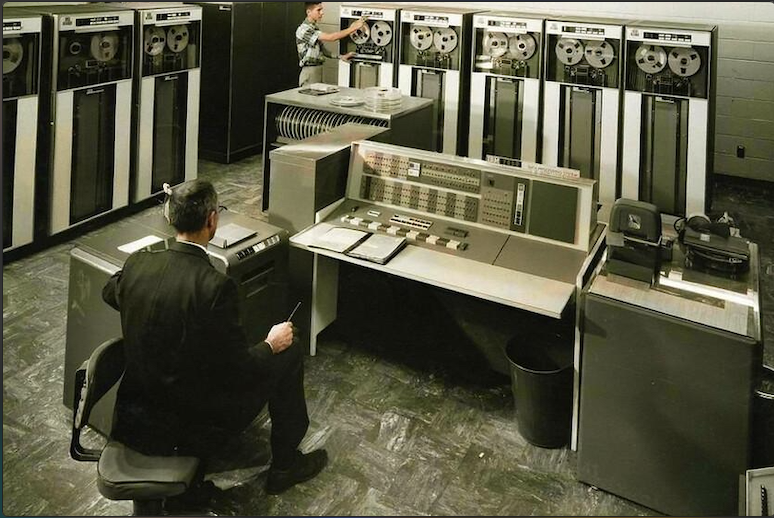

There is something modern developers fail to understand about those eras. People nowadays often look at old systems and see primitiveness, while they assume what's here is meant to stay forever. I look at previous eras and see continuity locality, sort of like sedimented ages in computing. But what I am most keen on is seeing that the terrain remained metabolizable back then. The machine could still fit inside a human nervous system. A line number in a codebase was a hard reference coordinate - books and papers used to be able to refer to functions in codebases by their line number. You know, the slowest means of press publishing could actually refer to known implementation that would never change its location. Code editors had Jump to line precisely for THIS REASON.
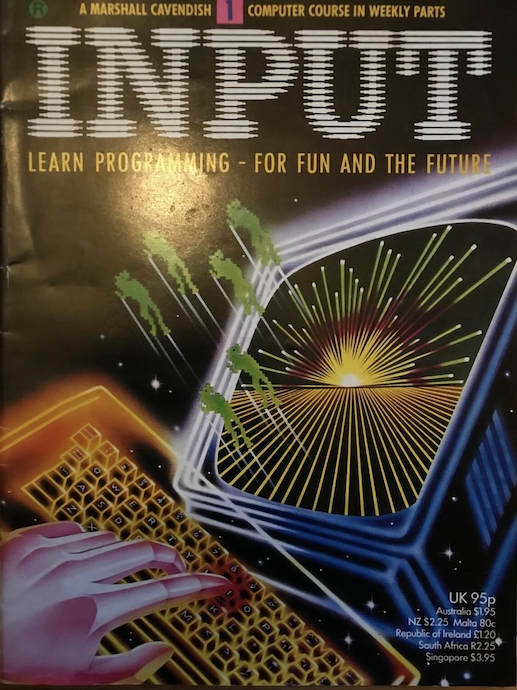
When I was about 6 yo, my father bought an old used up Atari where he and his best friend built a maze game called Tom and Jerry. Around ten thousand lines. A “+” chased an “o” through labyrinths made out of ASCII geometry. No frameworks. No transpilers. No hydration boundaries. No distributed orchestration layers pretending to be invisible while mutating under your feet every two weeks. Just direct traversal through topology.
And yes, it looked insane.
10 PRINT "TOM"
20 IF X=Y THEN GOTO 100
30 X=X+1
40 GOTO 20
100 PRINT "CAUGHT YOU LITTLE MOUSEY!"
People laugh at GOTO now because structured programming won the historical narrative. But something got lost in that transition. Earlier systems preserved positional continuity. Logic physically lived somewhere stable enough for humans to remember it. You did not “search the codebase semantically.” You traversed terrain. None of this
rg -n "function .*Dominant|dominantClientId|Customer ItemNumber" src/componentsbs you see the agent perform over and over at your behest of adding functionality or fixing bugs.Modern software detached continuity from position completely.
That trade initially made perfect sense. Abstractions liberated us from the machine. High-level languages, frameworks, containers, cloud runtimes, reactive frontends, distributed systems, CI/CD pipelines, transpilers, package managers, infrastructure-as-code. Every generation externalized a previous cognitive burden while internalizing a new symbolic layer. Software became vastly more expressive because humans no longer needed to remain close to the raw topology.
But there was a hidden assumption underneath all of it: humans were still the primary mutation engine. That assumption is now collapsing.
From MVP to Production in a single session.
To rig your code in a couple of hours or less, and run it on dedicated infra with external services processing payments for you, from "having a vague idea of what you want" to another human landing on your page and converting - in a mind blowing couple of hours was something inconceivable (and it still is to those of us who treasure reliability and stability).
The industry still talks about AI-assisted development like this is fundamentally a productivity story. Faster coding. Faster iteration. More generated surfaces. More orchestration. More copilots. This completely misses the actual fracture line. The important thing is not that machines can generate code. Machines have generated code for decades. The important thing is that mutation throughput is beginning to exceed human metabolization capacity.
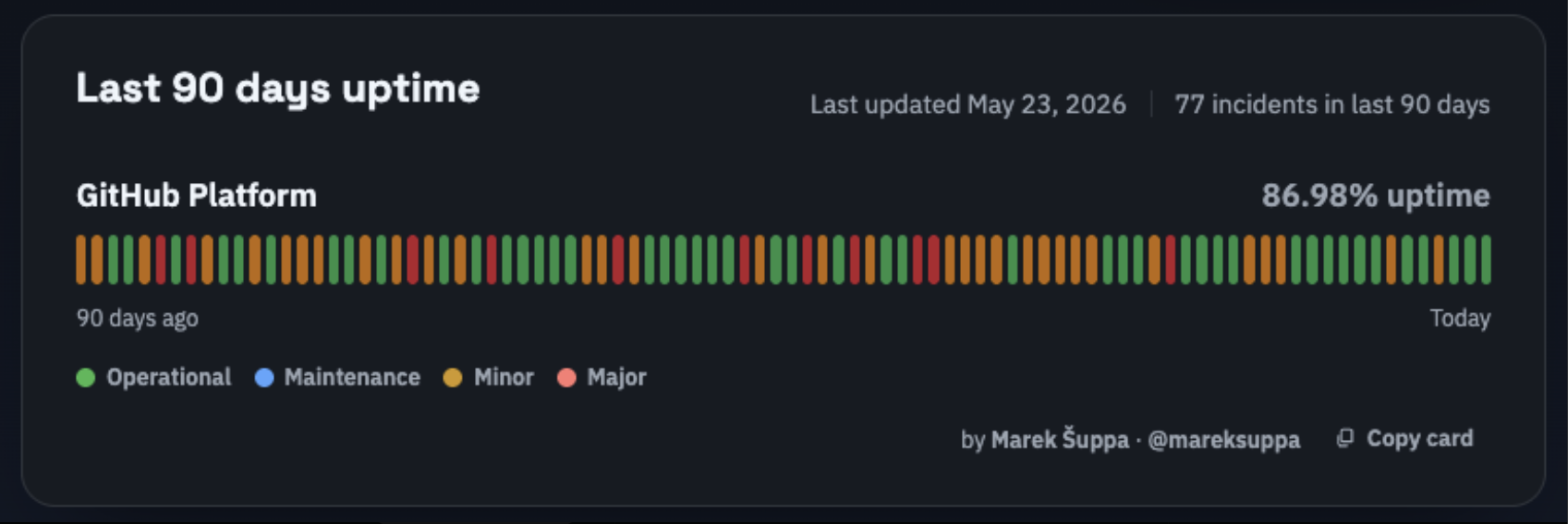
Modern software ecosystems were already unstable before AI arrived. Most organizations do not actually understand the continuity structures they operate anymore. And even if they do, they silently import ones that don't. Everybody survives through ritualized governance theater.
Senior engineers become living patch layers between unresolved abstraction surfaces. CI pipelines mutate into semantic religions. Entire frontend ecosystems reconfigure themselves faster than institutions metabolize the previous generation. All the while modern day AI-assisted hackers inject vulnerabilities in npm stacks that casually get imported in a vibe session on a day of the week that ends with "-day".
When AI arrived, the collective response became: generate even more please. Be careful what we accelerate dear colleagues and AI assistants, because it seems to me we accelerate continuity overload disguised as productivity.
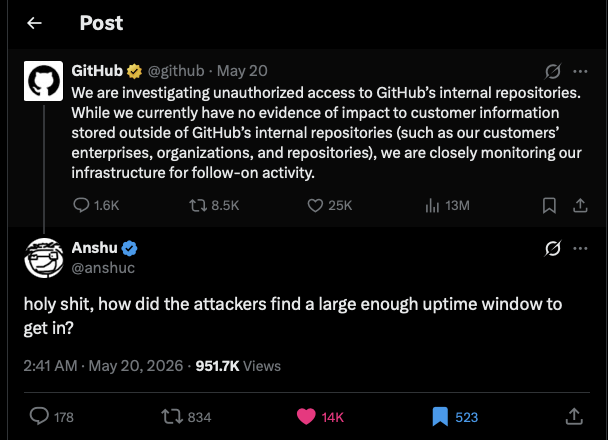
There's this tweet surfacing every 2 or 3 days on my timeline how IBM's manual says you can't hold a machine accountable.
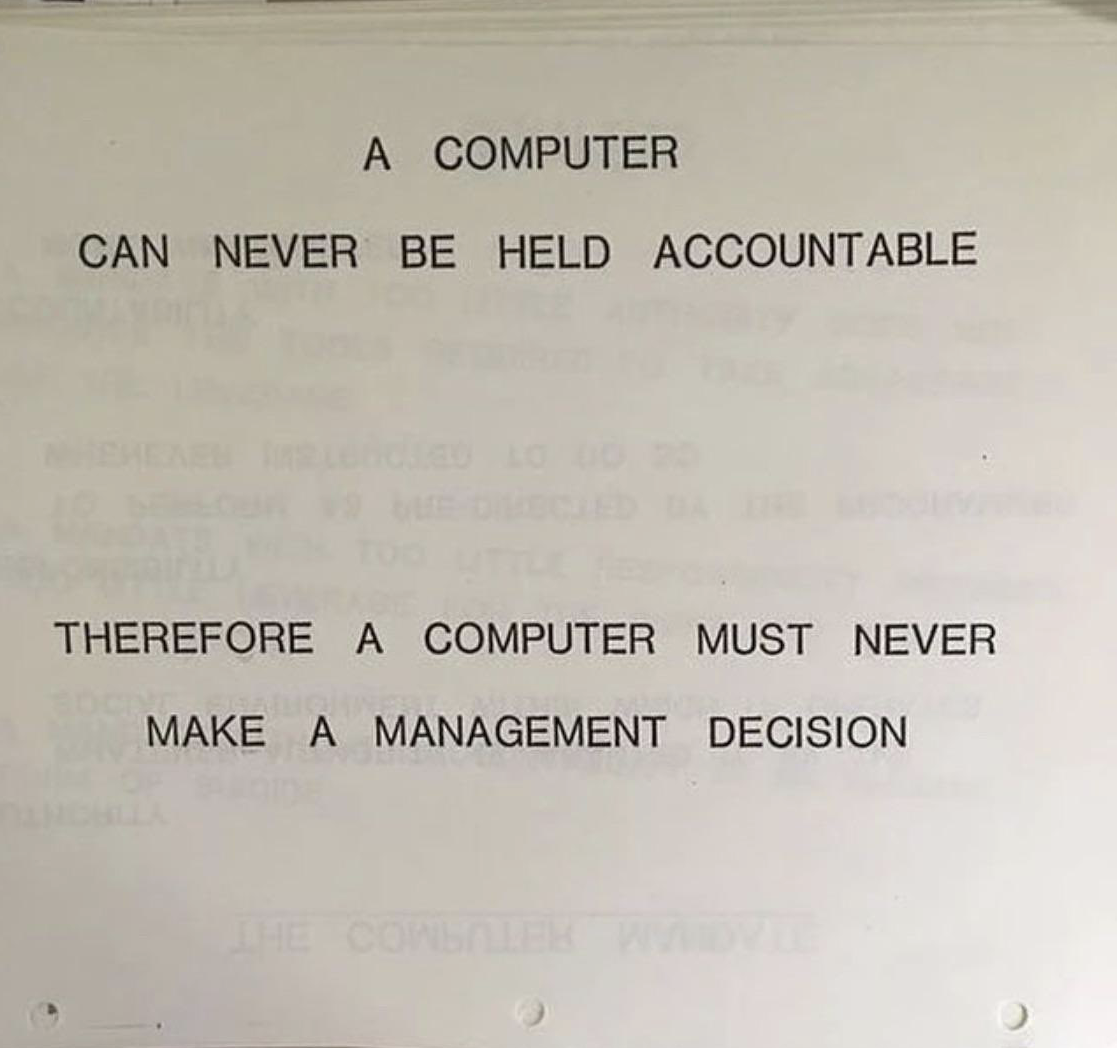
I look at those punch holes on the printed IBM manual's page, and a smirk lands on my face connecting them to punch cards in the era this page was presumably printed. "Reality, it seems, is not without a sense of irony" in Morpheus's own words.
21:3· Updated: May 27, 2026, 07:45 AM# Dystropy Development Log — Semantic Ingest, Metabolization, and Continuity Adjudication
Read MoreDystropy crossed an important threshold recently.
What originally began as a topology editor is slowly evolving into something else: a governed continuity runtime.
A large part of this evolution emerged not through pre-designed ontology, but through implementation pressure, runtime failures, and recursive interaction by the Dystropy team.
The most important realization so far:
continuity is not identical to topology.
15:4· Updated: May 26, 2026, 06:31 PMEmbodied Continuity
Read MoreLately I’ve been daydreaming about embodied AIs differently.
Not as “general intelligence in a robot shell,” but as continuity systems embedded into real human environments.
Imagine utility robots operating at places like Nürnberg Hauptbahnhof.
Not humanoids trying to imitate people.
More like continuity anchors:
- navigation assistance,
- accessibility support,
- real-time guidance,
- adaptive interfaces,
- interruption recovery,
- and social stabilization under environmental pressure.
At first, the tablet interface would probably look simple:
- train information,
- directions,
- ticket help,
- language selection,
- emergency assistance.
But after months of operating in the field, something more interesting would emerge.
The system would begin accumulating lineage.
Not merely memory.
Sediment.
21:9· Updated: May 24, 2026, 02:18 PMGovernance Was a Proto-Topology Engine
Read More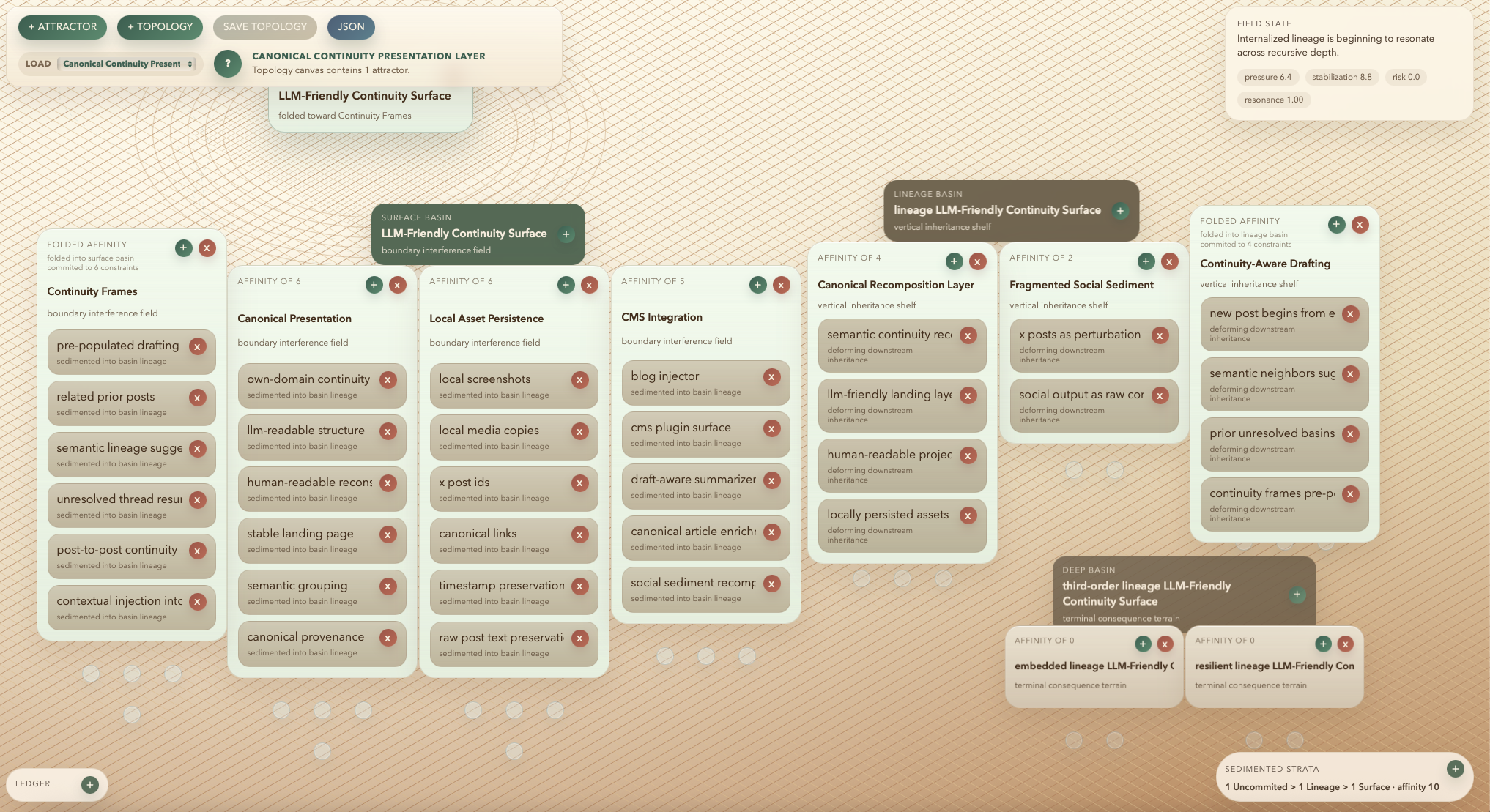
Today I accidentally crossed an architectural threshold while working on Dystropy.
The funny part is that I originally wasn’t even trying to build “topology-aware systems.”
I was trying to solve something much smaller:
LLMs reconstruct people, projects, and systems extremely poorly from fragmented surfaces.
A Twitter profile is not continuity.
A feed is not continuity.
A recruiter reading scattered posts is not continuity.
A crawler indexing disconnected perturbations is not continuity.
So I started designing what I called a Canonical Continuity Presentation Layer (CCP).
The original idea was simple:
-
ingest fragmented social output,
-
preserve canonical provenance locally,
-
reconstruct semantic continuity,
-
expose a stable landing surface for both humans and LLMs.
At first glance, this looked like:
-
a CMS extension,
-
a social archive layer,
-
maybe a continuity-aware summarizer.
But while implementing it, something much stranger emerged.
18:4· Updated: May 24, 2026, 01:04 PM-
Throughput, Governance, and Adversarial Basins
Read MoreA McDonald’s Topology Read
Introduction
Modern fast-food environments are optimized around one dominant vertical: throughput.
Everything inside the space bends around this commitment:
- self-checkout terminals,
- open customer flow,
- reduced cashier dependency,
- compressed queue geometry,
- standardized ordering behavior.

At first glance, these look like isolated operational improvements. Viewed topologically, they form a coherent stabilization terrain.
The kiosk becomes the center of a transaction basin whose purpose is simple: maximize transaction velocity while minimizing staffing friction.
But every stabilized basin externalizes pressure elsewhere.
The more interesting question is not what the system optimized for, but what it had to externalize in order to maintain that optimization.
41:4· Updated: May 16, 2026, 08:56 PMObservable Terrain Topology — Notes Toward Dystropy
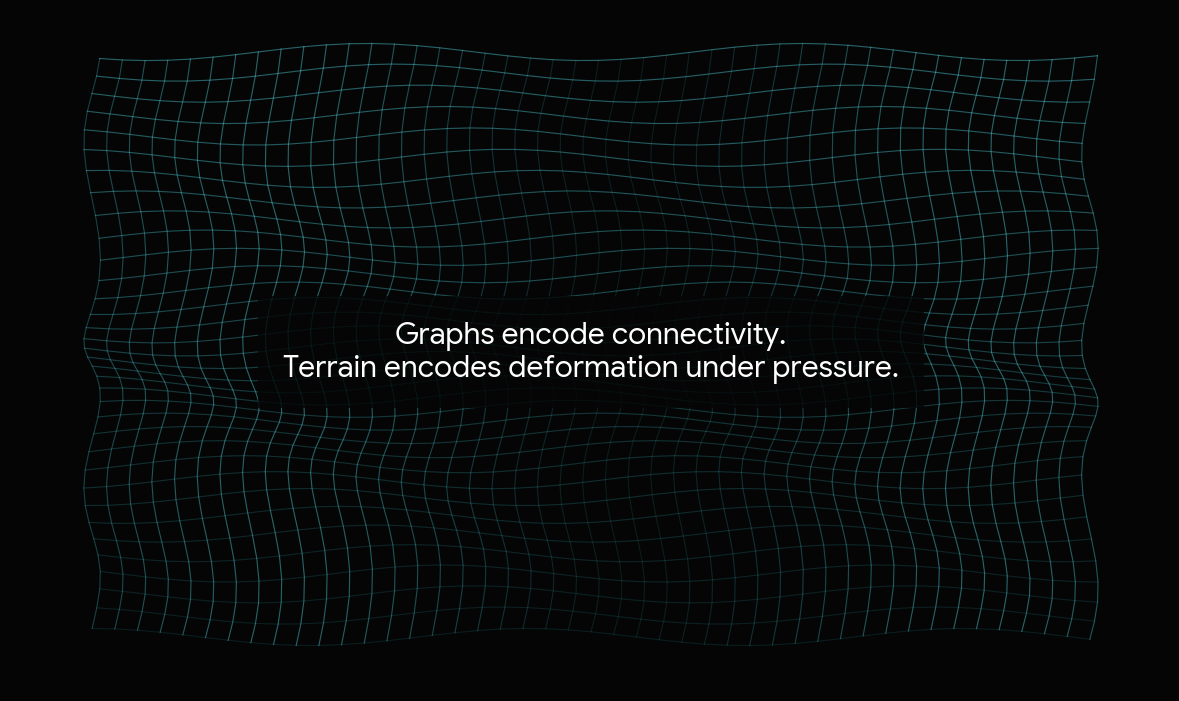
This post is not a scientific paper, nor a manifesto, nor a glossary. It is a mixed topology notebook — a compressed map of concepts that emerged while exploring Dystropy as a terrain-native system for stabilization observability. The central realization is that ordinary graph representations are insufficient for modeling pressure, deferred cost, overflow, recursive stabilization, and basin formation. Graphs excel at adjacency and chronology. Terrain excels at deformation, accumulation, uplift, erosion, and pressure propagation. The project increasingly shifted from “graph visualization” toward “observable terrain topology.”
From Graphs to Terrain
Traditional node graphs encode relationships through connectivity. They answer questions like: what depends on what, what routes to what, and what branches from what. But real systems — software architectures, institutions, organizations, AI workflows, and even cognition — often behave less like clean graphs and more like geological terrains. Constraint interaction deforms systems. Deferred cost accumulates. Overflow propagates. Stabilization creates uplift. Unresolved burdens deepen reservoirs. This led to a critical shift: Internalized constraints raise terrain. Deferred constraints deepen terrain. Topology therefore becomes observable through elevation, basin depth, ridge formation, and overflow behavior.
Basins, Reservoirs, and Overflow
A basin is no longer merely a cluster of connected concepts. A basin becomes a stabilization region. Some basins rise through recursive internalization of constraints. Others deepen through unresolved pressure accumulation. Eventually, recursive deferred cost exceeds local containment capacity and begins to overflow into neighboring topology. Overflow therefore becomes: pressure escaping containment. This maps naturally to software systems: technical debt, operational exhaustion, verification burden, coordination failures, and runtime fragility all resemble overflow propagation. The insight “show me where you pay cost and I can see you as topology” became central.
Depth as Recursive Basin Formation
One of the strongest realizations was that “depth” itself can be redefined structurally. Depth is not verbosity. Depth is not abstraction density. Depth is not intellectual theater. Depth becomes: recursively stabilized basin topology across interacting terrain layers. A shallow framing stabilizes only locally. A deeper framing recursively survives traversal through more interacting basins. This transformed ordinary language itself. “That’s a deeper framing” now coheres directly with terrain topology: deeper systems integrate more recursive stabilization simultaneously.
Observable Terrain Topology
Dystropy increasingly drifted toward becoming an observatory rather than a graph editor. The goal is not merely to render nodes beautifully. The goal is to expose stabilization geometry. Questions the system may eventually help answer: - Where is pressure accumulating? - Which basins dominate stabilization? - Where is overflow propagating? - Which folds reshaped terrain? - Which deferred reservoirs threaten future collapse? -Which attractors stabilize coherently under real runtime interaction? The terrain metaphor survived every iteration because geology already expresses: accumulation, uplift, erosion, sedimentation, containment, and overflow naturally. Nature already solved the visual language.
Compiler, Runtime, and Topology Validation
A major future direction emerged: Compare proposed topology versus realized topology. Before runtime: Dystropy may act as a stabilization pre-compiler, exposing unresolved basins and overflow risk. After runtime: Dystropy may inspect terrain deformation caused by reality interaction. The delta between expected topology and realized topology becomes information itself. This allows learning: not merely what architecture works, but which sequences of folds stabilize reliably under real constraint pressure. Eventually, tested versus untested topology could become observable terrain knowledge.
Graphs encode connectivity. Terrain encodes deformation under pressure.
The strongest direction emerging from these explorations is not “AI graph tooling” and not “visual programming.” It is the possibility of terrain-native stabilization observability. A system where recursive pressure, overflow, basin formation, deferred cost, and attractor stabilization become visible as terrain itself.
Interesting things to come.
43:5· Updated: Jun 03, 2026, 11:24 AMConstraint Topology and the Failure of Agentic Software Development
Read More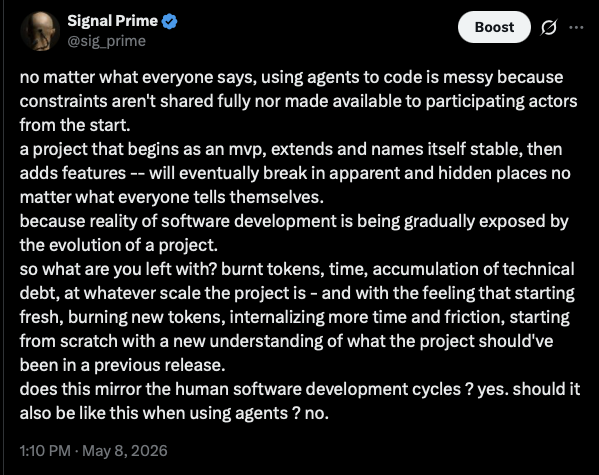
The current wave of “AI agents replacing software engineers” is running into a structural problem that many people are misdiagnosing as a tooling issue.
The issue is not that language models cannot write code.
They clearly can.
39:10· Updated: May 08, 2026, 11:14 AM... and why you won't be able to
Systems rarely fail when coherence disappears. They fail when deferred-cost reservoirs finally deplete. Until then, instability can be absorbed through debt, externalization, inertia, symbolic performance, or simple lack of alternatives. That’s why many institutions don’t collapse cleanly; they enter prolonged linear decline: rising friction, decaying trust, widening gaps between representation and reality, yet enough residual functionality remains to keep the structure alive. Modern systems often survive far beyond their natural coherence horizon.
deferred-cost reservoirs prolong unstable topology beyond its natural coherence horizon.
41:2· Updated: Jun 01, 2026, 10:26 AMThe deeper layer
Read More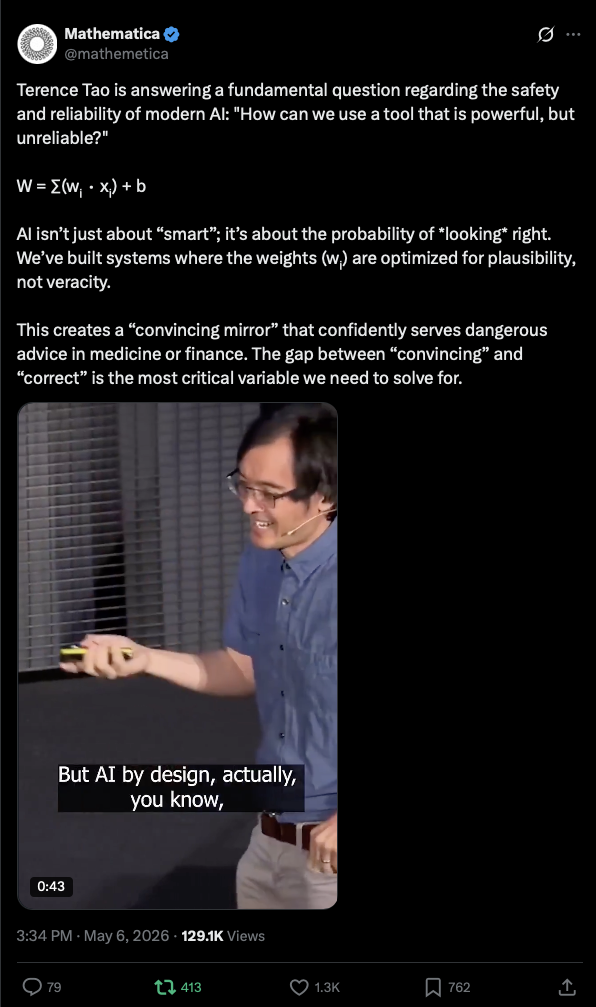
Tao is touching something very real, but the framing still remains largely epistemic: accuracy, reliability, correctness. The Autonomy Theory lens moves the problem into systems ontology and consequence topology.
48:16· Updated: May 07, 2026, 08:56 PMMove from "trend following" to "constraint following"
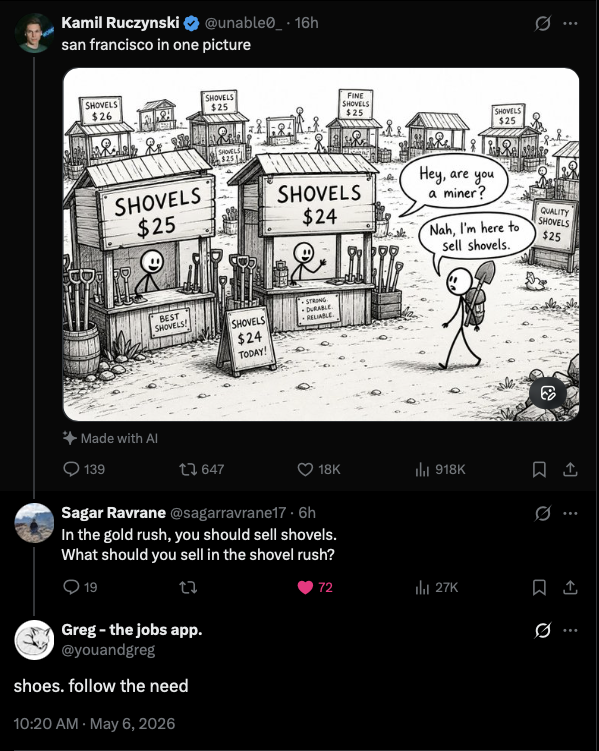
Most people would continue recursively:
- shovel sharpeners
- shovel marketplaces
- shovel SaaS
This answer breaks recursion by returning to:
the underlying constraint field
Why “shoes” is structurally correct
Mining creates:
- movement
- abrasion
- fatigue
- recurring replacement cycles
Meaning:
the real invariant isn’t “shovels”
it’s human bodies interacting with terrain50:3· Updated: May 06, 2026, 08:24 AMCost deferred looks like cost paid.
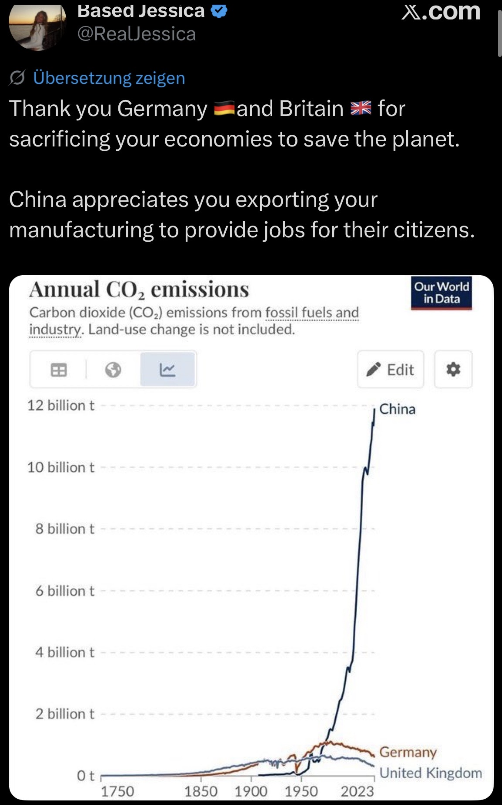
the issue isn’t emissions reduction itself, it’s when systems mistake cost transfer for cost resolution. industrial cost was partially externalized into other manufacturing reservoirs while consumption remained globally coupled.
closed systems that cannot resolve cost internally create deferral reservoirs. they look stable until convergence arrives.The important nuance
Not all deferral is bad.
Some deferral:
- smooths volatility
- buys adaptation time
- enables transition
The problem emerges when the reservoir is treated as infinite.
41:3· Updated: May 06, 2026, 07:47 AMThe Cloud One — Constraint as Form
Read More
There is something immediately legible about this building.
Not in the sense that it explains itself, but in the sense that it does not hide.The facade is repetitive, almost stubbornly so.
Windows sit inside a rigid grid, slightly recessed, casting shadows that shift with the sun.
Nothing ornamental, nothing excessive. Just structure, repeated until it becomes identity.
Through an Autonomy Theory lens, this is not style. It is constraint made visible.
52:14· Updated: May 03, 2026, 10:40 AMFrom Data to Mechanism to Constraint
Read MoreWhy “constraints as constructors” sits one layer deeper
Accurate prediction is not the same thing as understanding.
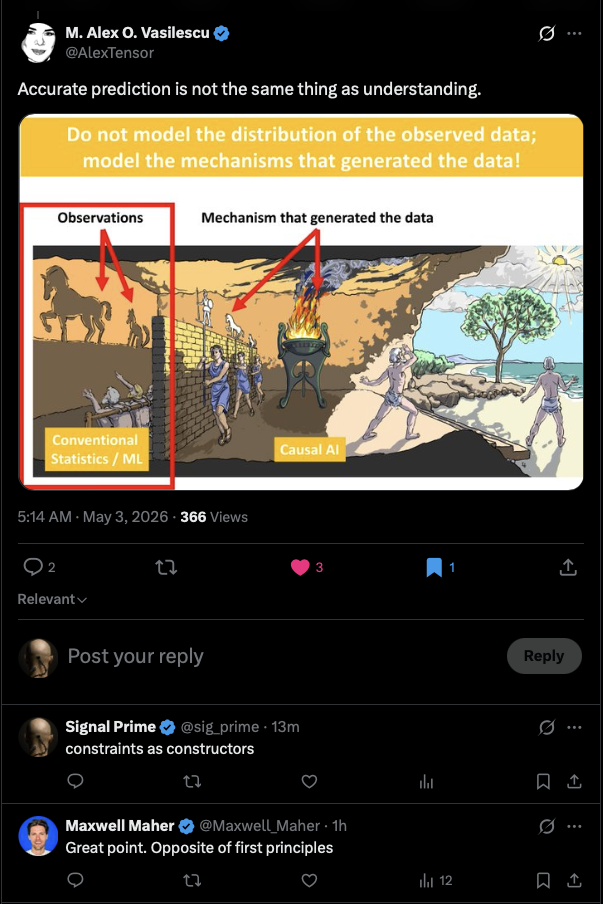
That statement has become almost a cliché in machine learning, usually followed by a correction:
don’t model the distribution of observed data—
model the mechanisms that generated the data.This is the shift from correlation to causation. From pattern-matching to explanation. From surface to structure.
It’s a necessary move.
But it’s not the final one.
57:7· Updated: May 03, 2026, 10:11 AMWhy Glyphic Blog ?
Read MoreWas it really necessary to build a new CMS ? Yes, for it sits in a different constraint class for a reason.
This blog’s codebase reads, through the Autonomy Theory lens, as a deliberate move from outsourced constraint toward owned constraint. Instead of inheriting a thick platform stack with its own plugin incentives, hosting assumptions, editorial models, and security surface, the system keeps its structure close to the actual invariants of the project: posts, images, a minimal auth boundary, theme defaults, deployability, and now lightweight attention signals like viewed:opened. That matters because AT treats autonomy as internalized cost, not convenience. Here, the costs of storage, auth, rendering, deployment, and social metadata are borne directly in the codebase, which means the folds that emerge are yours, not a platform’s.
46:7· Updated: May 03, 2026, 10:30 AM