Constraint Topology and the Failure of Agentic Software Development
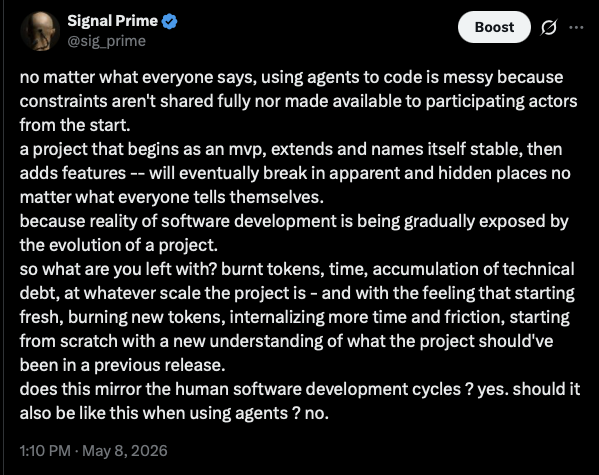
The current wave of “AI agents replacing software engineers” is running into a structural problem that many people are misdiagnosing as a tooling issue.
The issue is not that language models cannot write code.
They clearly can.
The issue is that software systems are not merely collections of files or functions. They are evolving topologies of interacting constraints accumulated across time.
And most participating actors — human or artificial — never possess the full constraint surface simultaneously.
This matters more than people think.
A project often begins coherently:
- a narrow MVP,
- a small set of assumptions,
- constrained scope,
- manageable architectural intent.
At this stage, the system’s topology is still relatively visible. The original authors understand:
- why certain abstractions exist,
- what tradeoffs were accepted,
- where technical debt was consciously deferred,
- and which invariants must remain stable.
But software does not remain static.
Features accumulate.
Requirements mutate.
Deadlines compress.
Different developers enter and leave.
Temporary solutions sediment into permanent structure.
Over time, hidden constraints begin interacting:
- naming conventions drift,
- duplicated logic emerges,
- abstractions leak,
- local optimizations conflict with global architecture,
- and historical assumptions continue operating long after the original conditions disappear.
The system slowly becomes partially opaque even to its own creators.
Human teams already struggle with this phenomenon.
Agentic coding systems amplify it.
Why?
Because most agentic workflows operate under fragmented visibility.
Each agent sees:
- partial files,
- partial context,
- partial intent,
- partial topology.
The agent may successfully solve a local problem while unknowingly destabilizing deeper structural invariants elsewhere.
This creates a dangerous illusion:
the project appears to evolve successfully because every individual step seems plausible.
But plausibility is not coherence.
A system can accumulate locally reasonable modifications while globally drifting toward instability.
This is why many AI-assisted projects eventually reach a strange psychological state familiar to experienced engineers:
- the project technically works,
- but feels increasingly fragile,
- harder to reason about,
- and progressively more expensive to modify safely.
At some point, reality catches up.
The hidden constraints finally collide.
Then comes the familiar cycle:
- rewrite discussions,
- architectural resets,
- “we should have done this differently from the beginning,”
- burning more time,
- more tokens,
- more energy,
- more coordination cost.
The irony is that many people interpret this as proof that software development is simply chaotic by nature.
It is not.
It is evidence that coherent constraint propagation failed.
The central problem is not intelligence.
It is shared topology.
A sufficiently advanced software system requires participating actors to internalize:
- architectural intent,
- historical cost,
- invariant boundaries,
- consequence surfaces,
- and evolving system geometry.
Without this, every actor optimizes locally against incomplete reality.
Entropy becomes inevitable.
This is why the future of serious AI-assisted software development likely does not belong to fully autonomous coding swarms blindly modifying repositories.
It belongs to systems capable of:
- preserving global constraint awareness,
- tracking architectural invariants,
- exposing hidden coupling,
- and maintaining coherent topology across time.
In other words:
the problem is not generating code.
The problem is carrying the structure that gives the code meaning.