# Dystropy Development Log — Semantic Ingest, Metabolization, and Continuity Adjudication
Dystropy crossed an important threshold recently.
What originally began as a topology editor is slowly evolving into something else: a governed continuity runtime.
A large part of this evolution emerged not through pre-designed ontology, but through implementation pressure, runtime failures, and recursive interaction by the Dystropy team.
The most important realization so far:
continuity is not identical to topology.
Topology is only stabilized terrain.
But real systems also contain:
- unresolved pressure,
- metabolization,
- replayable tension,
- staging,
- governance,
- adjudication,
- accumulation,
- continuity traversal history.
We repeatedly discovered that the runtime naturally generates semantically meaningful objects before the schema is ready to canonize them.
Instead of forcing premature ontology expansion, we stabilized a different approach:
Semantic Ingest Preview / Continuity Mutation Adjudication v1
The runtime now:
- classifies ingest before canonization,
- narrates continuity meaning before mutation,
- stages unresolved semantic objects,
- and allows accumulation of unresolved continuity pressure without forcing persistence.
This became necessary after introducing interaction candidates such as:
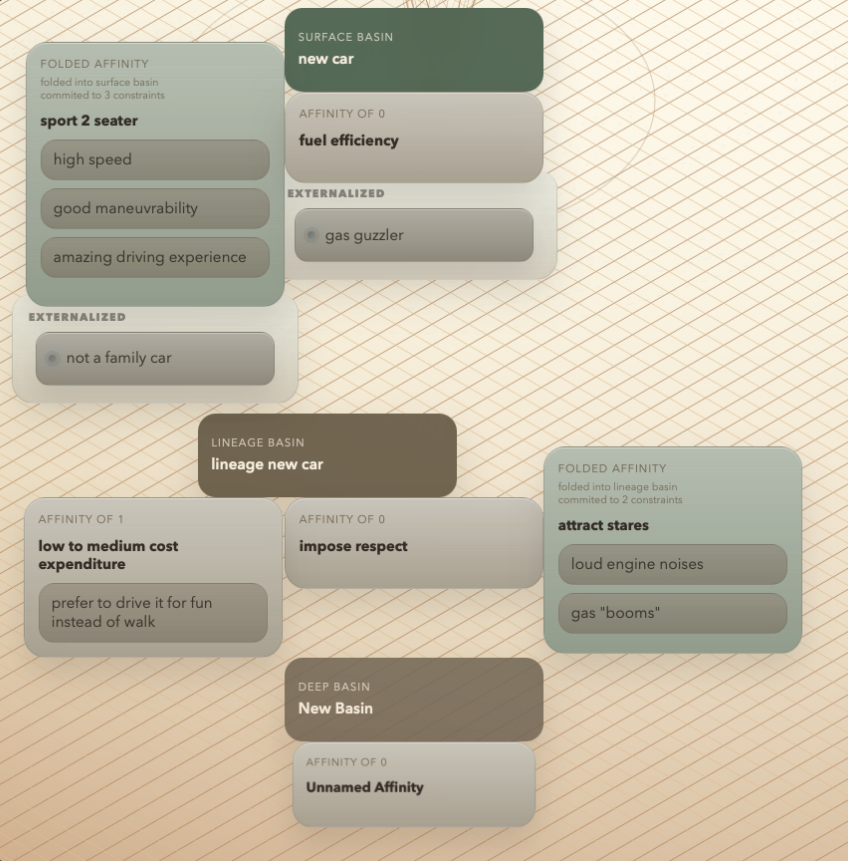
“gas guzzler interacts adversely with prefer to drive it for fun instead of walk”
{
  "source_constraint": "gas guzzler",
  "interaction_type": "interacts_adversely_with",
  "target_constraint": "prefer to drive it for fun instead of walk"
}
The important realization was that this object is meaningful, but it will not yet be canonically admissible.
Instead of:
- rejecting it,
- or expanding schema immediately,
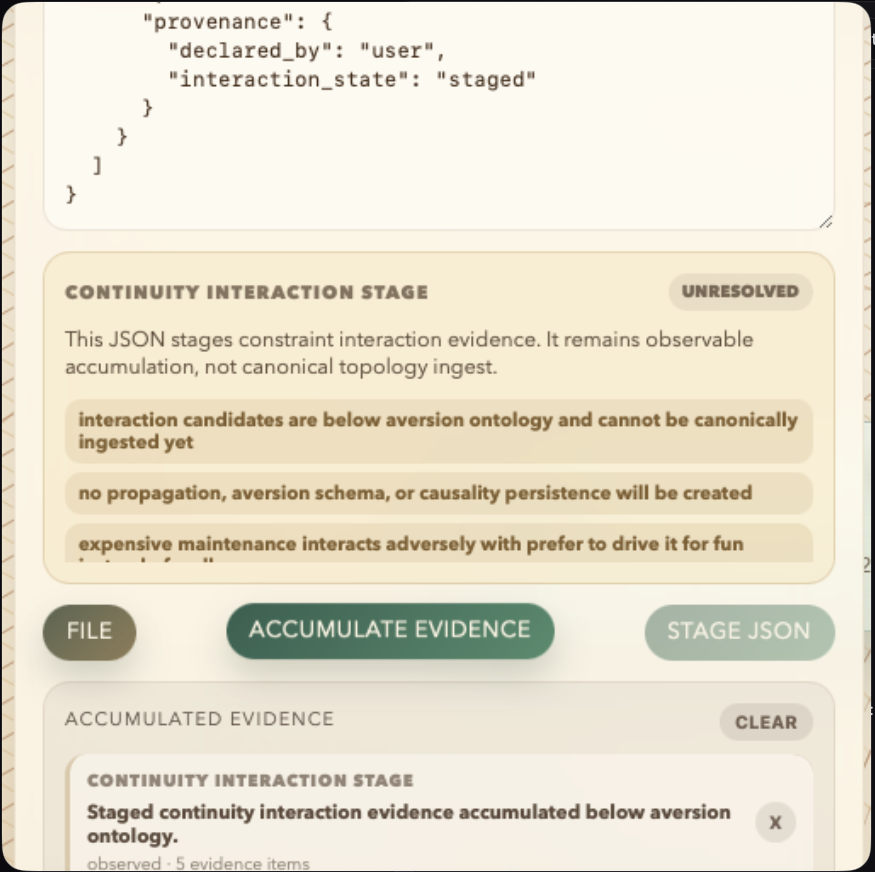
Dystropy now stages it as:
CONTINUITY INTERACTION STAGE
This distinction became extremely important.
The runtime can now:
- observe,
- narrate,
- replay,
- and accumulate unresolved continuity pressure,
without pretending it fully understands it yet.
Accumulated Evidence
We also stabilized a new basin:
Accumulated Evidence
This acts as a governance/runtime holding layer.
The runtime now supports:
- replayable unresolved continuity,
- retained semantic pressure,
- non-canonical interaction evidence,
- metabolization memory,
- and staged semantic sediment.
Importantly:
this avoids creating:
- aversion ontology,
- propagation graphs,
- causality persistence,
- or automated inference.
The system currently remains:
- human stabilized,
- governance first,
- inference last.
This sequencing matters enormously.
Metabolization vs Expansion
Another major runtime shift:
Dystropy now operates with two explicit postures:
- Metabolization
- Expansion
During metabolization:
- unresolved continuity pressure is foregrounded,
- expansion tooling is restrained,
- stabilization review becomes primary,
- and continuity interaction evidence accumulates.
Expansion becomes:
- explicit,
- intentional,
- manually resumed.
This emerged from realizing that systems should not endlessly expand while unresolved destabilization accumulates beneath them.
The Unexpected Convergence
One of the biggest surprises was realizing that speech ingestion, semantic JSON ingest, and staged continuity interaction all converge onto the same runtime pipeline.
Meaning:
raw continuity expression
→ staged continuity object
→ adjudication preview
→ accumulation or canonization
This means future speech-to-text ingestion will likely use the same governed semantic staging substrate already stabilized through JSON ingest.
Runtime First, Ontology Last
Probably the healthiest architectural shift so far:
Earlier Dystropy often tried to:
- invent ontology first,
- formalize meaning early,
- sediment semantics immediately.
Now the architecture increasingly follows: runtime pressure
→ staging
→ accumulation
→ metabolization
→ replay
→ recurrence
→ adjudication
→ only then canonization
This feels dramatically more stable.
Emerging Realization
The deeper realization slowly appearing underneath all of this:
Understanding always arrives looking late.
The runtime moves first.
Pressure accumulates first.
Perturbation happens first.
Only afterward does explicit semantic understanding stabilize.
Dystropy is increasingly becoming a system capable of holding partially understood continuity without forcing premature collapse.
That may turn out to be its most important property.