A coherent constraint appears to reorganize relevance.
There is a strange moment in the life of an idea when it stops being something you are thinking about and starts changing what the world looks like. Every idea is at first only a statement. Then it becomes a project, and if it's strong enough, it becomes a lens.
Once it arrives as a lens, concepts that were previously irrelevant begin to light up.
This is, in my view, an important sign that an idea has made the crossing from concept into a basin.
Initial observations
I was thinking about Friendbox a social network where reading is digital but posting is physical. The idea is staggeringly simple: if something exists on paper and came through in an envelope, it can exist on Friendbox - as they state it on their bio. If it didn't physically arrive, it cannot.
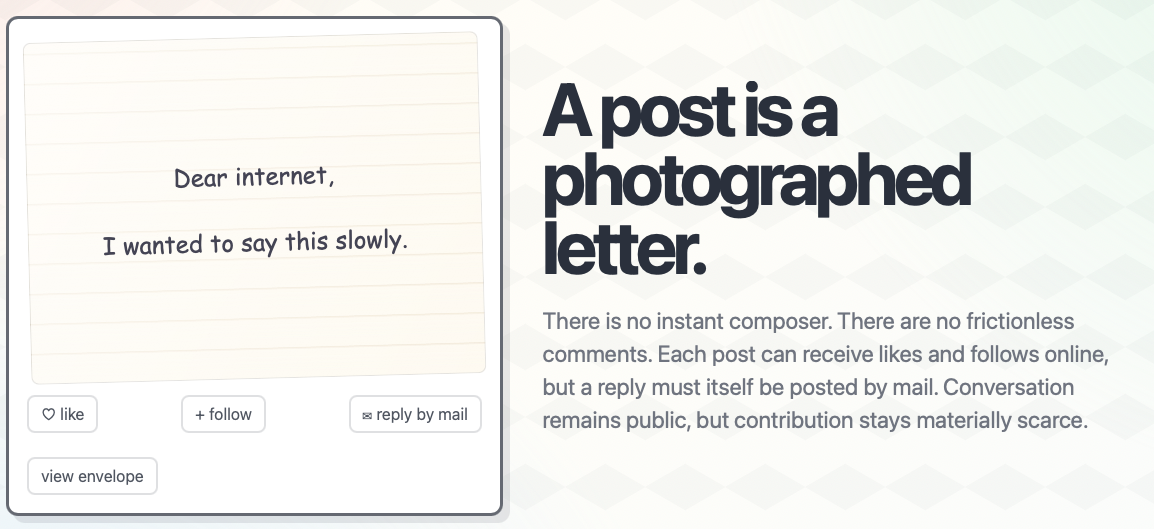
Coherent ideas attract neighboring structures
At first this sounds like a product constraint, but after sitting with the idea, something unexpected started taking root. Prior concepts became interesting again: stamps, postcards, mailboxes, handwriting... Even envelopes of different colors, shapes, customizations ... became focal attractors.
Then suddenly, today, I saw a "bargain sale" for an old Polaroid camera for $10. Even Polaroid cameras suddenly began feeling interesting again. All because of a single constraint: physicality.
And "curiouser and curiouser", as Alice in Wonderland might put it ... not because Friendbox required them. Friendbox doesn't automatically imply: collecting stamps, Polaroid photos or stationery nostalgia, typewriting or postcards per se. But once the posting constraint became structural rather than cosmetic, physicality started resonating again. Friendbox is not about any of these in particular, yet somehow all of them started gathering around it by means of affinity.
This is important especially because products don’t normally do that. A note-taking app doesn’t suddenly make fountain pens relevant. A messaging app doesn’t suddenly make postcards relevant.
The gateway from "product description" into "relevance reorganization" became active.
Friendbox appears to be activating an entire neighborhood of physical artifacts around itself. That’s the phenomenon worth studying.
Let's test this philosophy.
Spotify
What suddenly becomes relevant?
- playlists
- headphones
- speakers
Mostly direct dependencies.
WhatsApp
What becomes relevant?
- contacts
- phone numbers
Again, direct dependencies.
Google Docs
What becomes relevant?
- documents
- collaboration
Nothing surprising.
Now Friendbox:
- stamps
- envelopes
- handwriting
- postcards
- typewriters
- Polaroids
- stockbooks
- stationery
- fountain pens
- mailbox photography
- provenance
- arrival rituals
Most of these are not direct dependencies.
They’re affinity structures. Half of these aren’t even objects. They're behaviours. Or aesthetics. Or practices. Or values. Which means the basin isn’t merely attracting things. It’s attracting across categories.
A dependency graph usually stays within category. An affinity field crosses categories.
Dependencies tell you what a system needs.
Affinity structures tell you what a system becomes compatible with.
Ruling out direct causation
If we want to strengthen the argument, we'd go about adding a negative test.
- IF friendbox disappears tomorrow WOULD stamps | Polaroids | fountain pens | stockbooks also disappear ? *
No. They all exist independently. Yet they become selectively meaningful, in the presence of Friendbox. That rules out direct causation. What's left is affinity.
The list of affinity structures that resonate with Friendbox are not a feature set, nor a dependency graph, they strongly resemble an ecology. And ecologies are usually signs that you’ve discovered a coherent constraint rather than merely designed a product.
The bigger picture
Stepping away from Friendbox for a moment, I suspect there is a more general principle at work. We tend to think of constraints as things that remove possibilities, but their more interesting property may be that they generate affinity. A sufficiently coherent constraint does not merely narrow a solution space; it reorganizes relevance within it. Things that were previously unrelated begin to resonate, not because they are required, but because they share a deeper compatibility with the constraint itself. Stamps, Polaroids, stockbooks, fountain pens and postcards were never dependencies of Friendbox, yet they became increasingly meaningful once the posting constraint stabilized. This suggests that coherence is not merely the assembly of compatible parts. Rather, coherence emerges when a strong constraint creates a field of affinity around itself, allowing compatible structures to discover one another. The constraint comes first. The ecosystem follows.
One reason I find this observation particularly interesting is that it mirrors a question I have been exploring while building Dystropy. Most systems today are optimized around producing outputs: answers, documents, images, code, recommendations. Dystropy begins from a different premise. What if the more important question is not what a system generates, but what it makes relevant? If coherent constraints generate fields of affinity, then perhaps ideas, projects, organizations, and even people can be understood by examining the ecosystems that naturally emerge around them. The appearance of recurring concepts, objects, practices, and values may not be noise at all. They may be the visible shape of coherence itself. In that sense, Dystropy is increasingly becoming an attempt to study not merely the outputs of systems, but the relevance landscapes they create around themselves.