Governance Was a Proto-Topology Engine
Today I accidentally crossed an architectural threshold while working on Dystropy.
The funny part is that I originally wasn’t even trying to build “topology-aware systems.”
I was trying to solve something much smaller:
LLMs reconstruct people, projects, and systems extremely poorly from fragmented surfaces.
A Twitter profile is not continuity.
A feed is not continuity.
A recruiter reading scattered posts is not continuity.
A crawler indexing disconnected perturbations is not continuity.
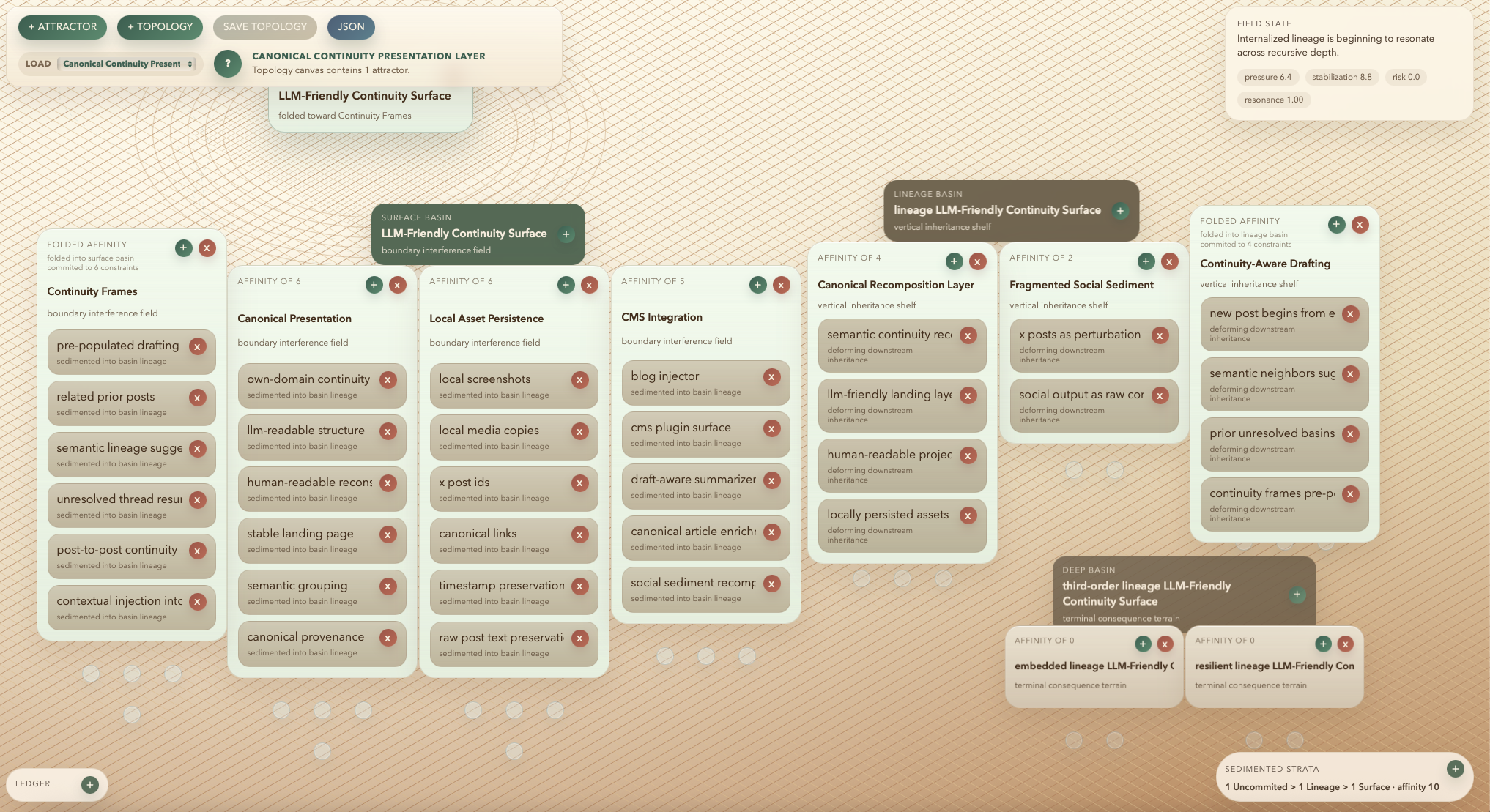
So I started designing what I called a Canonical Continuity Presentation Layer (CCP).
The original idea was simple:
-
ingest fragmented social output,
-
preserve canonical provenance locally,
-
reconstruct semantic continuity,
-
expose a stable landing surface for both humans and LLMs.
At first glance, this looked like:
-
a CMS extension,
-
a social archive layer,
-
maybe a continuity-aware summarizer.
But while implementing it, something much stranger emerged.
The Real Problem Was Ownership Continuity
The actual issue was not scraping.
It was:
who owns continuity?
Who owns:
-
the topology,
-
the lineage,
-
the persistence boundary,
-
the governance surface,
-
the stabilization history?
This is where Dystropy started folding back onto itself.
Because I realized I had already built a primitive version of this years earlier.
Not in Dystropy.
In /governance.
Governance Was Already Proto-Dystropy
My governance repo originally looked like:
-
glyph registries,
-
mesh indexes,
-
governance constraints,
-
lineage references,
-
anti-drift rules,
-
codename stabilization,
-
migration continuity.
At the time I thought I was building:
-
process,
-
documentation,
-
project discipline.
But post-hoc, the structure reveals something else entirely.
/governance was already behaving like a topology engine.
The mesh was already:
-
reconstructing continuity,
-
preserving lineage,
-
preventing ontology drift,
-
stabilizing semantic identity across mutations.
I simply lacked:
-
runtime visualization,
-
basin projections,
-
affinity folding,
-
persistence-aware topology operations.
Dystropy emerged later as the runtime realization of those pressures.
The Architectural Threshold Crossed Today
Today we implemented something extremely small technically.
But architecturally, it matters a lot.
Dystropy can now:
-
hot-load an external topology,
-
operate on it live,
-
preserve runtime attachment metadata separately,
-
save it back into its own repository,
-
commit into that repository’s ledger,
-
without absorbing it into Dystropy itself.
This sounds mundane.
But this is the first moment where Dystropy became capable of:
operating on structures it does not own
That distinction matters enormously.
Because ownership continuity is now explicit.
The topology belongs to its own repository.
Its lineage belongs to its own persistence history.
Its governance belongs to its own stabilization surface.
Dystropy merely operates on it.
Repositories Are Not Just Storage Boundaries
This is where things became weird.
Because the moment we introduced:
-
external topology ownership,
-
independent persistence domains,
-
continuity-preserving runtime mutation,
the repositories themselves stopped behaving like folders.
They started behaving like basins.
The CCP layer is not “a new project.”
It is topologically adjacent to:
-
the Anghene blog CMS,
-
the governance repository,
-
Dystropy itself,
-
the continuity and observability pressures that produced them.
Its shape is partially inherited from those sediment layers.
This is not metaphorical anymore.
The implementation path itself begins changing under continuity pressure.
Planning Started Becoming Topology-Aware
The strangest part was noticing that ordinary implementation planning began failing.
Flat task decomposition became insufficient.
Because continuity itself had become architectural state.
You can no longer freely mutate:
-
lineage,
-
persistence boundaries,
-
ownership surfaces,
-
canonical projections,
-
governance layers,
without creating ontology drift.
So the implementation process itself started requiring:
-
basin preservation,
-
affinity folding,
-
continuity-aware mutation,
-
reconstructible stabilization history.
Which means governance is no longer merely documentation.
Governance becomes topology.
The Broader Realization
I increasingly suspect that many current software systems are missing an entire architectural layer.
Most systems preserve:
-
files,
-
state,
-
databases,
-
commits,
-
deployments.
But they poorly preserve:
-
semantic continuity,
-
identity continuity,
-
mutation rationale,
-
topology ownership,
-
unresolved architectural pressure.
And once AI systems begin participating in development, this missing layer becomes catastrophic.
Because AI expands mutation velocity dramatically.
Without continuity-preserving structures:
-
local fixes silently redefine ontology,
-
semantic responsibilities drift,
-
lineage becomes unreconstructible,
-
and eventually systems stabilize into pathological basins.
This is precisely the terrain Dystropy is beginning to explore.
Final Thought
Today I realized that what I originally called “governance”
was actually an attempt to preserve continuity under recursive architectural mutation.
And what looked like:
-
CMS tooling,
-
social reconstruction,
-
observability systems,
-
topology visualizers,
may all actually be manifestations of the same underlying pressure:
preserving structural identity while systems evolve.