Throughput, Governance, and Adversarial Basins
A McDonald’s Topology Read
Introduction
Modern fast-food environments are optimized around one dominant vertical: throughput.
Everything inside the space bends around this commitment:
- self-checkout terminals,
- open customer flow,
- reduced cashier dependency,
- compressed queue geometry,
- standardized ordering behavior.

At first glance, these look like isolated operational improvements. Viewed topologically, they form a coherent stabilization terrain.
The kiosk becomes the center of a transaction basin whose purpose is simple: maximize transaction velocity while minimizing staffing friction.
But every stabilized basin externalizes pressure elsewhere.
The more interesting question is not what the system optimized for, but what it had to externalize in order to maintain that optimization.
The Throughput Basin
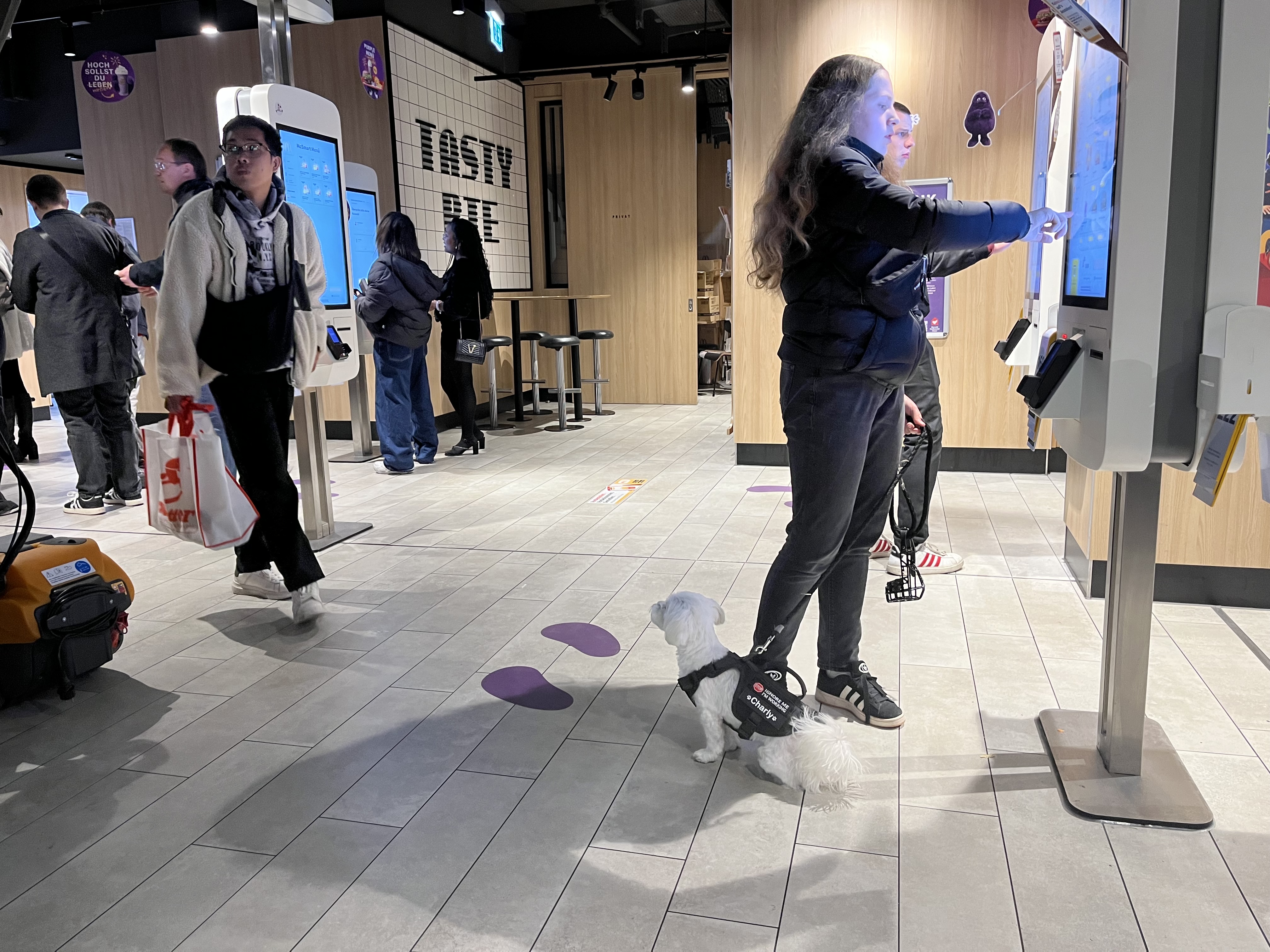
The self-checkout terminal internalizes several important constraints simultaneously.
It reduces transaction bottlenecks by parallelizing customer interaction. Customers no longer wait for a cashier. Ordering becomes decentralized across multiple terminals. Staff attention shifts away from repetitive transaction handling toward fulfillment and operational continuity.
The floor topology reflects these commitments directly:
- kiosk placement,
- walking corridors,
- standing angles,
- payment accessibility,
- and queue spacing.
The environment becomes a physical expression of throughput logic.
From the perspective of the business, this stabilization is highly efficient:
- fewer transactional bottlenecks,
- lower staffing dependency,
- faster customer cycling,
- higher sustained order volume.
But the stabilization introduces second-order effects beneath the surface.

Governance Externalization
As transaction flow decentralizes, governance decentralizes with it.
Traditional cashier systems concentrate observation at a narrow interaction boundary. Self-service systems dissolve that boundary into the floor itself.
The result is attention fragmentation.
Workers distribute themselves across:
- customer assistance,
- machine support,
- order recovery,
- delivery handling,
- cleanup,
- kitchen coordination,
- and maintenance work.
This creates intermittent low-governance windows where transaction surfaces remain operationally active but weakly observed. Importantly, the system remains functional under these conditions. Throughput survives. Customers continue moving.
Which means the topology can tolerate substantial governance degradation before immediate operational failure occurs.
Adversarial Basin Overlap
This is where the environment becomes especially interesting from a systems perspective.
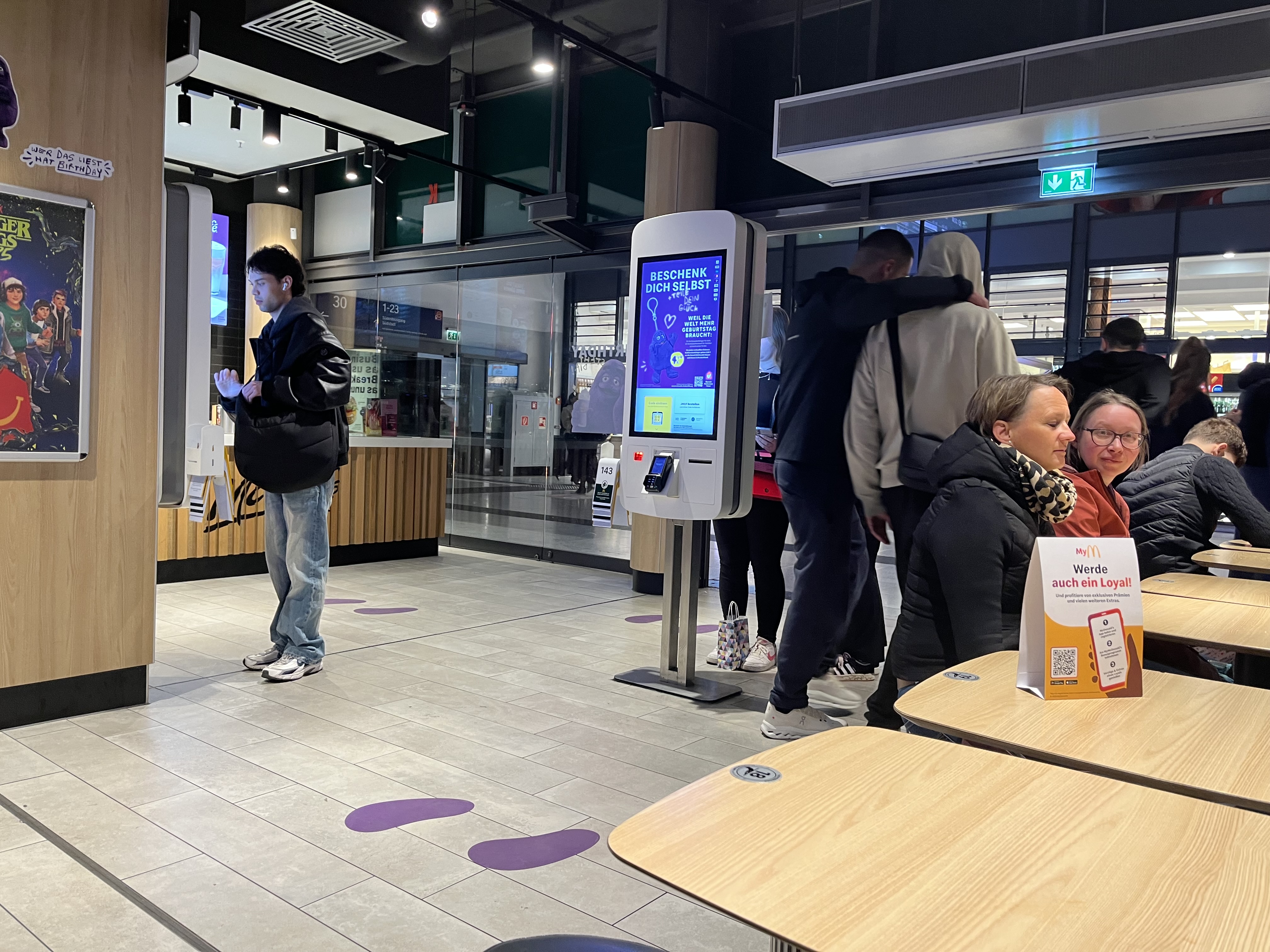
An adversarial basin oriented toward transaction skimming does not fundamentally oppose the throughput basin. Instead, it benefits from many of the same favorable conditions:
- rapid transaction flow,
- reduced scrutiny per interaction,
- crowded environments,
- habitual customer behavior,
- and fragmented staff attention.
The overlap intensifies during high-pressure windows:
- football evenings,
- delivery surges,
- school rushes,
- late-night traffic spikes.
During these periods:
- noise increases,
- floor density rises,
- worker attention disperses further,
- anomaly visibility decreases.
The throughput basin strengthens itself precisely when governance visibility weakens.
This creates a favorable stabilization terrain for adversarial overlap.
Delayed Corrective Pressure
One of the most important structural observations is that downstream consequences distribute away from the local topology. If transaction skimming occurs, the immediate burden rarely collapses directly onto the restaurant itself.
Instead, the pressure disperses across:
- customers,
- banks,
- fraud departments,
- payment processors,
- delayed fraud detection,
- and attribution uncertainty.
This weakens local corrective feedback.
The restaurant continues functioning normally because much of the resulting instability is absorbed elsewhere in the broader financial ecosystem.
From a topological perspective, the system gains protection through distributed untraceability and delayed consequence visibility.
The Governance Refold Problem
A naive response would attempt to increase security pressure everywhere simultaneously.
But aggressive governance refolds destabilize the original throughput basin:
- transaction speed decreases,
- customer friction rises,
- workers overload cognitively,
- and operational continuity weakens.
The challenge therefore becomes structural rather than moral.
How do you increase governance density without collapsing throughput efficiency?
This is a topology problem.
The goal is not maximum security. The goal is reducing overlap between throughput-favorable and adversarial-favorable conditions.
Coherent Refold Candidates
A coherent refold preserves the core throughput commitments while redistributing governance pressure more intelligently.
Several structural refolds emerge naturally:
- rotating ambient staff visibility,
- improved sightline geometry,
- separating payment interaction from congestion corridors,
- adaptive governance scaling during peak windows,
- dedicated floor-governance roles,
- passive terminal integrity verification,
- and topology-aware queue restructuring.
These interventions work because they alter stabilization geometry rather than merely increasing enforcement intensity.
The objective is simple: make adversarial stabilization expensive again without collapsing transaction flow.
Conclusion
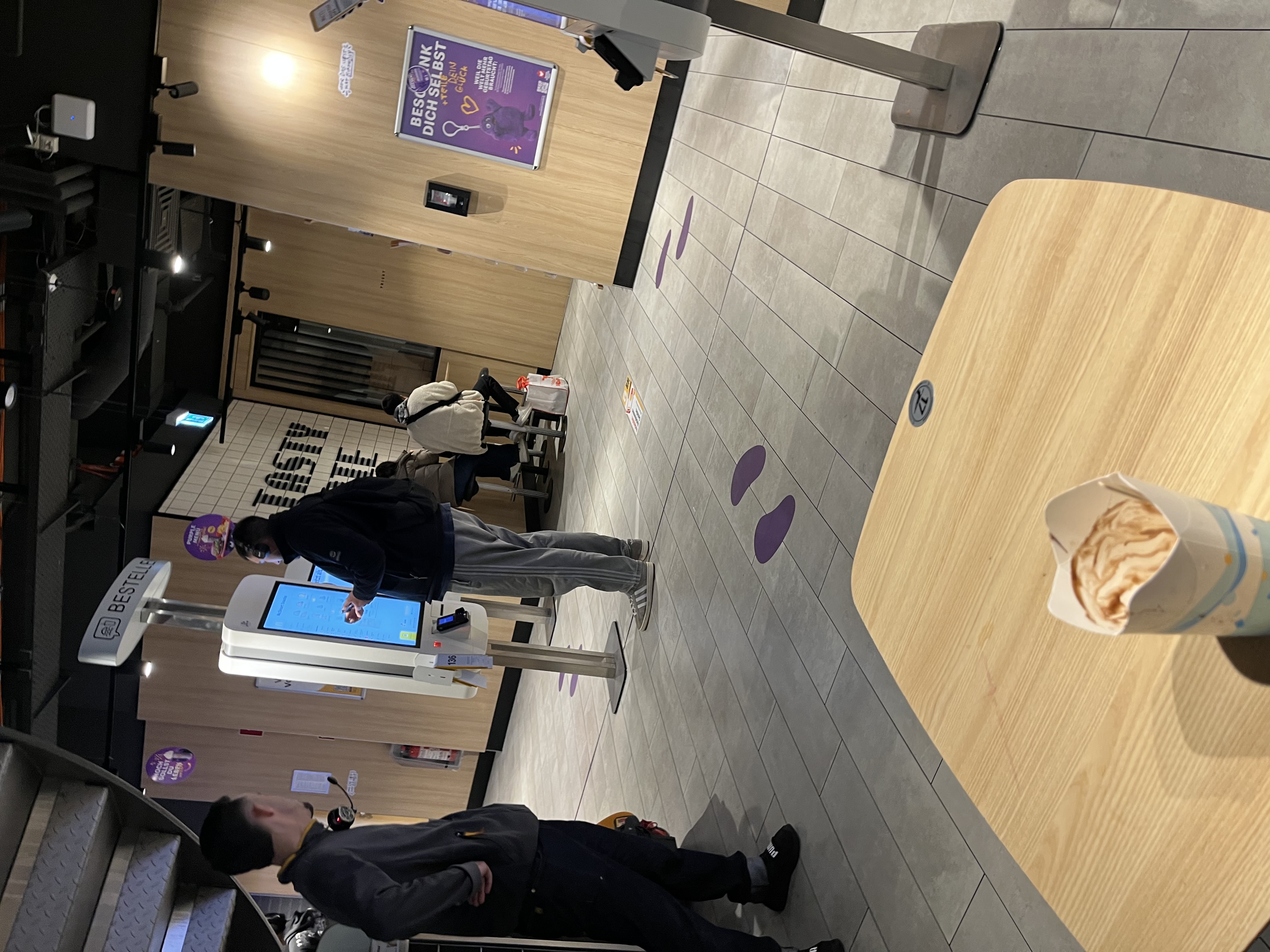
The McDonald’s kiosk serves as a useful case study because it reveals how modern systems stabilize themselves through layered constraint negotiation.
The environment internalizes:
- speed,
- scalability,
- and customer autonomy.
At the same time, it externalizes:
- governance density,
- anomaly detection,
- and portions of transaction vigilance.
This pattern appears everywhere:
- train stations,
- software systems,
- organizations,
- institutions,
- payment infrastructures,
- and digital platforms.
Every stabilization terrain displaces pressure somewhere else. The deeper systems question becomes:
What constraints had to be externalized for this topology to remain stable?
Organizations increasingly optimize for local throughput while unknowingly externalizing governance, maintenance, and adversarial pressure into other parts of the system. The ability to read these hidden stabilization terrains before they accumulate into operational fragility may soon become a critical advantage for companies operating at scale. If your organization is dealing with complex operational environments, high-throughput customer interaction surfaces, or distributed governance challenges, I am currently exploring consultation work focused on topology analysis, pressure propagation, and stabilization-aware system design. DM me on X