Why Glyphic Blog ?
Was it really necessary to build a new CMS ? Yes, for it sits in a different constraint class for a reason.
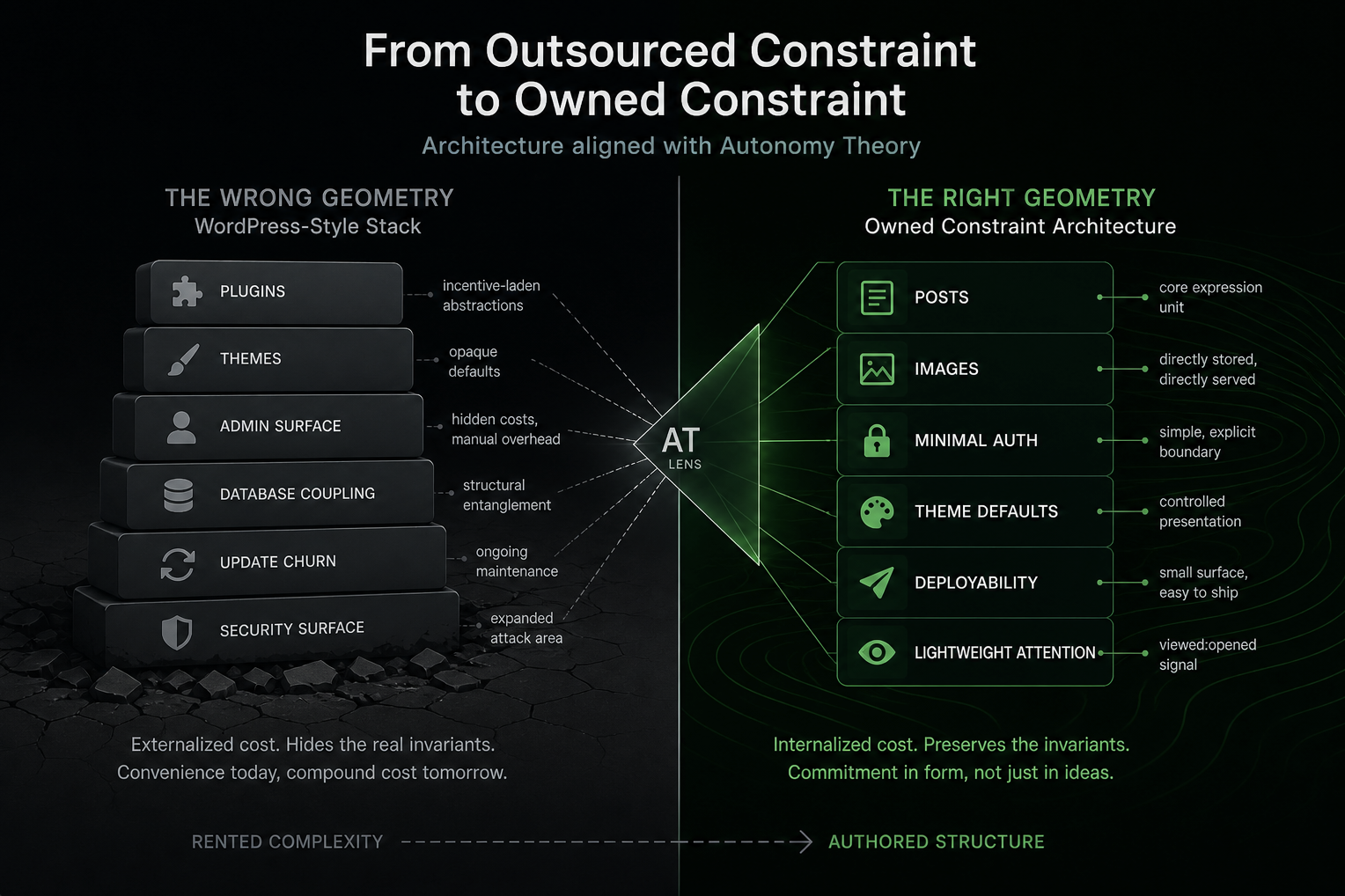
This blog’s codebase reads, through the Autonomy Theory lens, as a deliberate move from outsourced constraint toward owned constraint. Instead of inheriting a thick platform stack with its own plugin incentives, hosting assumptions, editorial models, and security surface, the system keeps its structure close to the actual invariants of the project: posts, images, a minimal auth boundary, theme defaults, deployability, and now lightweight attention signals like viewed:opened. That matters because AT treats autonomy as internalized cost, not convenience. Here, the costs of storage, auth, rendering, deployment, and social metadata are borne directly in the codebase, which means the folds that emerge are yours, not a platform’s.
That is also why a WordPress-style solution would have been the wrong geometry for this project. WordPress lowers immediate effort, but it externalizes a great deal of structural cost into themes, plugins, opaque admin surfaces, database coupling, update churn, and incentive-laden abstractions built for the average publisher rather than this specific system. In AT terms, that kind of convenience often keeps a project in orientation without real commitment: you can operate, but mostly inside someone else’s invariant field. This repo does the opposite. It accepts irreversibility where it matters, like custom deploy hardening, SSR social cards, explicit theme persistence, and a file-backed data model that is simple enough to be fully legible. The result is less generic power, but more authored structure.
So the codebase feels needed not because custom software is inherently nobler, but because the blog itself appears to be part of the theory’s expression. The medium is supposed to preserve identity, not dissolve it into defaults. A bespoke Nuxt and Express stack lets the site remain small enough to understand end to end, while still carrying the real costs of publication, change, and maintenance inside the system rather than hiding them behind rented machinery. Through AT, that makes the blog more than a content container: it becomes a self-governing object whose technical form is aligned with the same commitment logic its ideas are trying to articulate.